Common Skiing Mistakes Mid-Season (And How to Fix Them)
The Most Common Skiing Mistakes We See Mid-Season
(And How to Fix Them)
By mid-season, most skiers are already spending full days on the mountain.
They feel more confident, ski faster, and rack up plenty of vertical meters.
And yet — this is exactly when progress tends to stall.
At BeBetter, after reviewing hundreds of skiing videos from recreational and advanced skiers, we see the same pattern every winter:
The same technical mistakes appear again and again once the season is underway.
The good news?
Most of these issues are fixable during the season — if you know what to look for and how to correct them.
Why mid-season is when mistakes get locked in
Early in the season, skiers are cautious.
They think about technique.
Mid-season, confidence increases — but awareness often drops.
That combination leads to:
- Habits becoming automatic
- Compensations replacing clean technique
- Progress plateauing despite skiing every weekend
Let’s break down the most common mid-season skiing mistakes — and how to fix each one.
1. Sitting back instead of staying centered
What we see
- Hips behind the feet
- Weight loaded on the heels
- Skis accelerating out of control on steeper terrain
This often appears after a few weeks of skiing, when speed increases but body awareness doesn’t.
Why it happens
- Fatigue later in the season
- Steeper runs than early winter
- Defensive skiing instead of active balance
How to fix it
- Focus on ankles and shins, not your upper body
- Maintain light pressure on the front of the boots throughout the turn
- Practice short-radius turns on moderate slopes to rebuild balance
Video tip
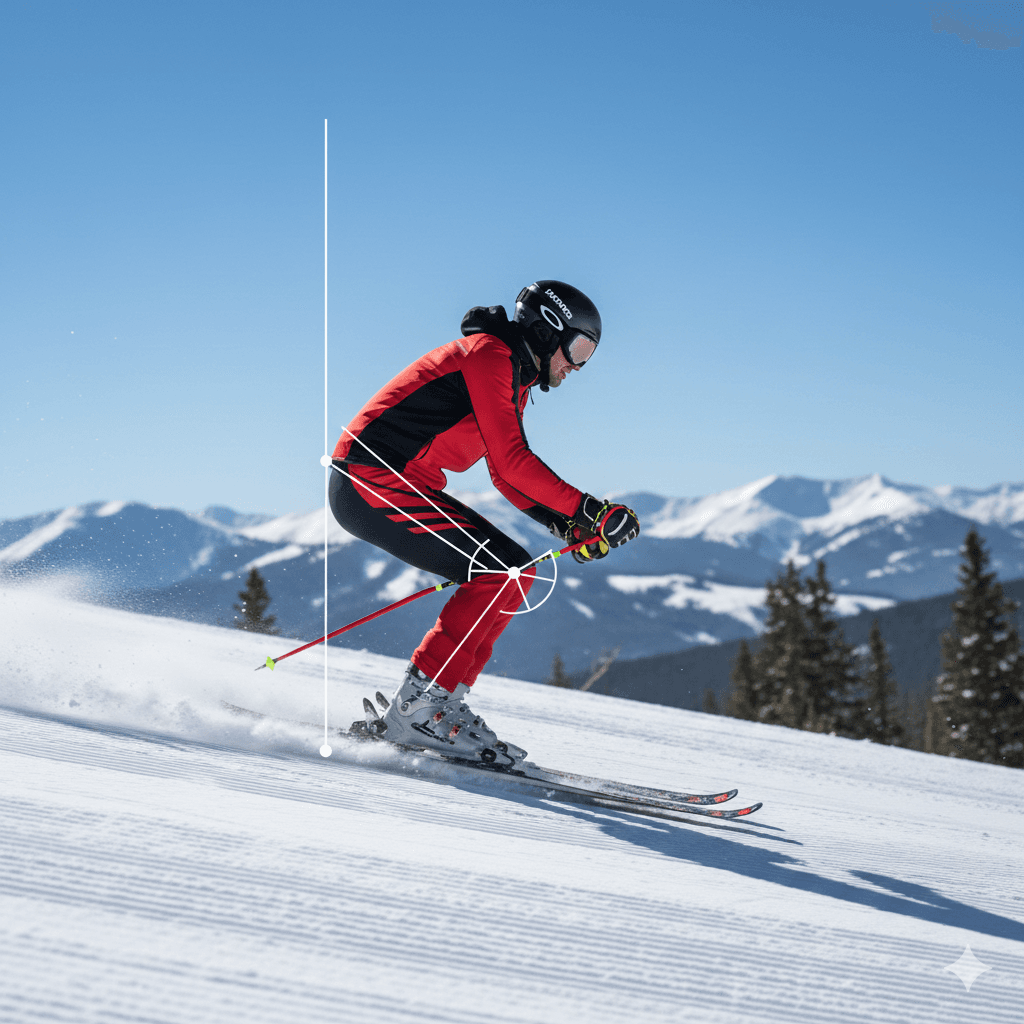
In side-view footage, draw a vertical line from your boots.
If your hips are consistently behind it, this mistake is present.
2. Upper body rotation through the turn
What we see
- Shoulders turning with the skis
- Hands drifting backward
- Loss of stability at higher speeds
This mistake is extremely common mid-season, especially in carving.
Why it happens
- Trying to force turns instead of letting the skis work
- Fatigue causing loss of upper–lower body separation
How to fix it
- Keep your chest facing downhill
- Keep your hands visible in your peripheral vision
- Initiate turns with the lower body, not the shoulders
Video tip
If your shoulders rotate more than your hips in slow motion,
this is a clear signal.
3. Late edge engagement
What we see
- Skis sliding at the start of the turn
- Sudden edge grip late in the arc
- Loss of rhythm and flow
Why it happens
- Rushing into turns
- Not committing to early pressure
- Over-skidding to control speed
How to fix it
- Start edge engagement before the fall line
- Think round turns, not sharp direction changes
- Slow down slightly to regain precision
Drill
Practice garland turns on a groomed slope
to feel early edge pressure.
4. Static stance instead of dynamic movement
What we see
- Minimal vertical movement
- Same body position in every turn
- Difficulty adapting to terrain changes
Why it happens
- Skiing on autopilot
- Lack of feedback during the season
- Fatigue reducing range of motion
How to fix it
- Actively flex and extend through turns
- Absorb terrain instead of resisting it
- Focus on smooth transitions, not speed
5. Skiing more — but not improving
This is the most important one.
Many skiers assume:
“If I ski every weekend, I’ll naturally get better.”
In reality, repetition without feedback reinforces mistakes.
Why progress stalls mid-season
- No objective feedback
- No visual reference of technique
- No clear correction plan
How to fix it
- Film short runs regularly
- Review technique with a clear framework
- Apply one correction at a time
This is exactly why we built BeBetter —
to close the gap between skiing more and skiing better,
using structured video feedback and technical analysis.
How video analysis accelerates mid-season improvement
Seeing your own skiing changes everything.
With video:
- Mistakes become obvious
- Corrections become measurable
- Progress becomes intentional
Even short clips can reveal:
- Balance issues
- Timing problems
- Upper vs. lower body coordination
The key is knowing what to look for — not just watching yourself ski.
Final thoughts: mid-season is not too late
If you’re already skiing this season and feel stuck, that’s normal.
But it’s also the best moment to intervene.
Small technical adjustments now can:
- Unlock confidence
- Reduce fatigue
- Improve control
- Make the rest of the season far more enjoyable
Progress doesn’t come from skiing more runs —
it comes from better feedback loops.
If you want structured, actionable feedback on your skiing,
this is exactly what BeBetter was designed for.